Hourly vs Flat-Rate Billing: How Freelancers Choose the Right Model
Choosing between hourly and flat-rate billing determines how freelancers get paid and who bears project risks. This guide compares risk allocation, effective hourly rates, and scope management strategies.

Choosing between hourly and flat-rate billing determines how freelancers get paid and who bears project risks. Freelancers choose hourly billing for open-ended or evolving projects, while flat-rate billing works best for clearly defined project outputs with locked requirements.
Hourly vs Flat-Rate Billing Comparison for Freelancers
Freelancers should choose hourly billing when project scope is uncertain or evolving, and select flat-rate billing when project scope and revision counts are strictly defined.
Selecting the right pricing model changes how independent contractors manage time, handle revision requests, and calculate profitability. Hourly billing ties income directly to the exact number of hours worked. Flat-rate billing sets a single total fee for completing a defined set of project outputs regardless of time spent.
Neither pricing structure works for every client engagement. Understanding how each model allocates financial risk helps service providers choose the correct method for each contract.
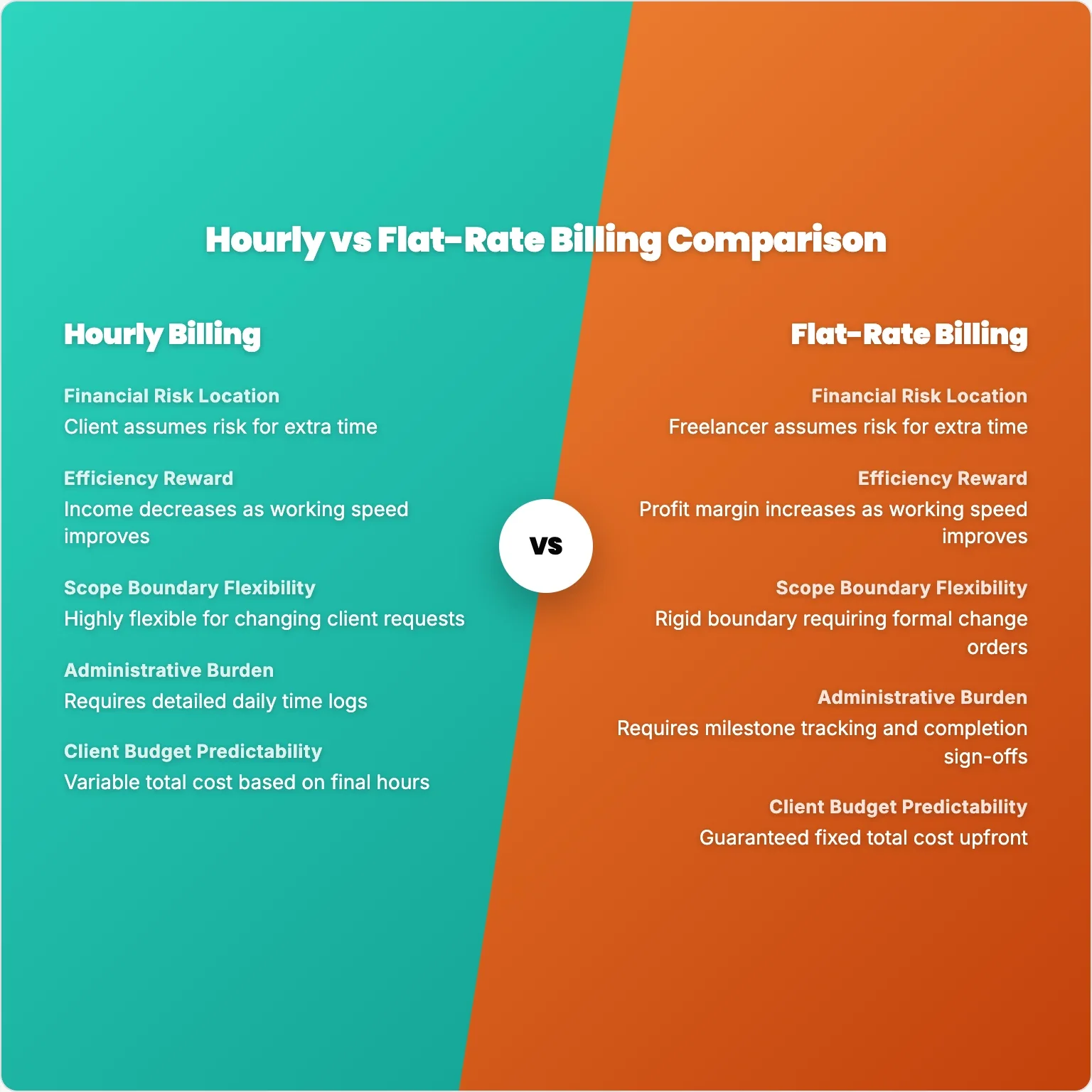
The comparison table below details how these two billing structures operate across core business metrics:
| Metric | Hourly Billing Model | Flat-Rate Billing Model |
|---|---|---|
| Financial Risk Location | Client assumes risk for extra time | Freelancer assumes risk for extra time |
| Efficiency Reward | Income decreases as working speed improves | Profit margin increases as working speed improves |
| Scope Boundary Flexibility | Highly flexible for changing client requests | Rigid boundary requiring formal change orders |
| Administrative Burden | Requires detailed daily time logs | Requires milestone tracking and completion sign-offs |
| Client Budget Predictability | Variable total cost based on final hours | Guaranteed fixed total cost upfront |
Freelancers managing complex client contracts often learn how to invoice as a freelancer by adjusting their payment terms to match project complexity.
How Hourly Billing Functions for Service Providers
Hourly billing functions by multiplying recorded work hours by an agreed hourly rate, transferring the financial risk of extra time to the client.
Under an hourly billing contract, a freelancer tracks every minute spent on client tasks. The total billable time is recorded in a log and billed at a set hourly fee. This model protects service providers when working with clients who change project requirements mid-way through execution.
When a client adds extra meetings, requests additional mockups, or delays feedback, every additional hour is billed directly to the client account. This structure prevents unpaid labor on open-ended projects.
Worked Example of Hourly Project Billing
A freelance software developer agrees to an hourly rate of $85 per hour for custom application feature development. The client provides an initial outline but expects to refine features during testing.
- Week 1: 15 hours spent on database setup and initial logic ($1,275).
- Week 2: 22 hours spent on front-end integration and client feedback changes ($1,870).
- Week 3: 18 hours spent on bug fixing and deployment ($1,530).
- Total Project Hours: 55 billable hours.
- Final Invoice Amount: 55 hours multiplied by $85 per hour equals $4,675.
Because the project scope shifted during testing, the developer received full payment for all 55 hours worked. Had this project been billed at a flat rate estimated for 35 hours ($2,975), the developer would have contributed 20 uncompensated hours.
Advantages of Hourly Billing
Hourly pricing offers specific operational protections for freelancers handling complex client requests:
- Scope Expansion Protection: Every extra revision or added feature translates directly into billable revenue.
- Low Initial Estimation Risk: Freelancers do not need exact historical data before starting a project.
- Fair Compensation for Communication: Time spent in client meetings, email threads, and phone calls counts toward billable hours.
Disadvantages of Hourly Pricing
Hourly billing also creates structural limits on freelance income growth:
- Capacity-Constrained Ceiling: Total income is strictly capped by the number of physical hours a freelancer can work each week.
- Efficiency Penalty: Speed improvements reduce total billable hours, effectively lowering total revenue for faster work.
- Client Monitoring Friction: Clients often inspect detailed time logs, questioning specific task durations and administrative entries.
Freelancers using hourly rates should establish clear payment schedules, such as standard Net 30 payment deadlines, to keep cash flow steady.
How Flat-Rate Billing Functions for Service Providers
Flat-rate billing functions by charging a fixed total price for a completed project brief, transferring project efficiency risk and profit potential to the freelancer.
Flat-rate billing, also known as fixed-price billing, sets one total fee for a specific list of work items. The client knows the exact cost of the project before work begins. The freelancer agrees to complete the defined scope for that fixed amount, regardless of whether it takes 10 hours or 30 hours.
This billing model decouples freelance earnings from logged time. When a freelancer completes work faster through experience, specialized tools, or established templates, the effective hourly earnings increase.
Worked Example of Flat-Rate Project Billing
A freelance graphic designer agrees to design a corporate brand identity package for a flat fee of $3,200. The written agreement specifies one logo concept, a brand style guide, business card layouts, and up to two rounds of revisions.
- Estimated Time: 32 hours (calculated at an internal target rate of $100 per hour).
- Actual Time Spent: 20 hours due to efficient design workflows and fast client feedback approvals.
- Total Fixed Fee Billed: $3,200.
- Effective Hourly Rate Achieved: $3,200 divided by 20 hours equals $160 per hour.
Because the designer completed the agreed project tasks efficiently, the effective hourly rate increased from the initial target of $100 per hour to $160 per hour.
Advantages of Fixed-Price Invoicing
Flat-rate billing provides distinct commercial benefits for experienced service providers:
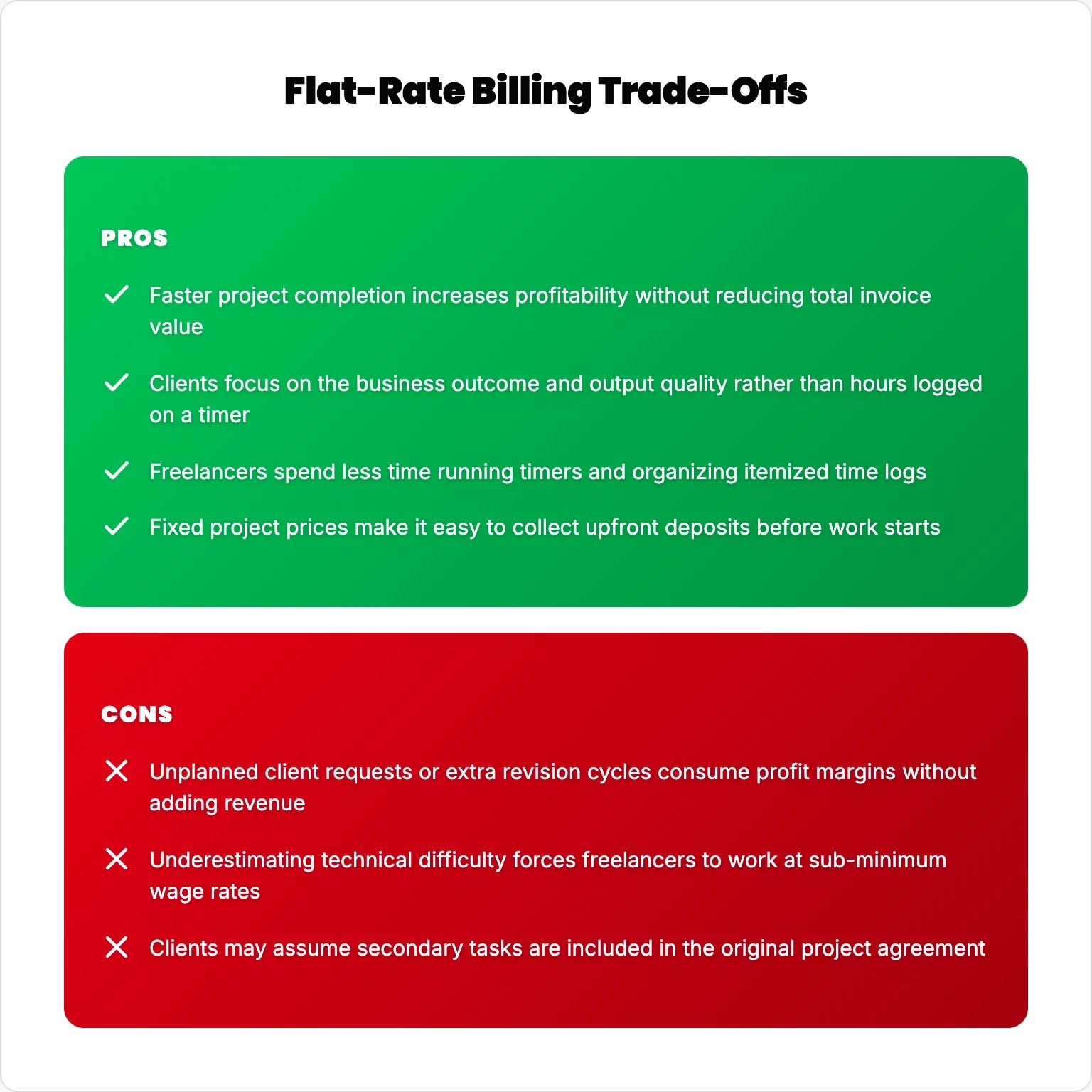
- Efficiency Rewards: Faster project completion increases profitability without reducing total invoice value.
- Value-Based Positioning: Clients focus on the business outcome and output quality rather than hours logged on a timer.
- Administrative Simplicity: Freelancers spend less time running timers and organizing itemized time logs.
- Upfront Payment Collection: Fixed project prices make it easy to collect upfront deposits before work starts.
Disadvantages of Fixed-Price Invoicing
Fixed pricing creates severe financial risks when project boundaries are poorly defined:
- Asymmetric Scope Risk: Unplanned client requests or extra revision cycles consume profit margins without adding revenue.
- Estimation Errors: Underestimating technical difficulty forces freelancers to work at sub-minimum wage rates.
- Unclear Boundary Disputes: Clients may assume secondary tasks are included in the original project agreement.
Contractors managing multiple fixed-price projects often need to track project additions, similar to how contractors learn itemizing client project expense claims on detailed client statements.
Financial Risk Allocation in Freelance Pricing Models
Financial risk shifts between client and contractor depending on whether the project uses an hourly rate or a fixed project fee.
Understanding risk distribution helps freelancers select the appropriate billing structure for each contract. Every client agreement contains two main risks: time risk and scope risk.
Time risk refers to the uncertainty of how long a task will take to complete. Scope risk refers to the potential for project requirements to change during execution.
Risk Distribution Analysis
When a freelancer charges by the hour, time risk and scope risk rest with the client. If technical challenges arise or project directions change, the client pays for the extra billable hours required to complete the work.
When a freelancer charges a flat fee, time risk and scope risk transfer entirely to the freelancer. If a task takes twice as long as anticipated, the contractor absorbs the additional labor cost.

Revision Buffer Threshold Contract Clause Script
To control scope risk under flat-rate contracts, freelancers must include a written revision buffer clause in their Statement of Work.
Project Revision Buffer Clause:
This flat-rate project fee includes up to two (2) rounds of revisions for each defined task. All revision requests must be submitted in writing within five (5) business days of work submission. Additional revision rounds, structural scope modifications, or new feature requests outside the original Statement of Work will be billed separately at the contractor's standard hourly rate of $90 per hour under a formal Change Order.
This clause creates a clear boundary between fixed-price work and out-of-scope hourly tasks.
Calculating Your Effective Hourly Rate Across Pricing Models
Effective hourly rate equals total project revenue divided by total hours spent, revealing true profitability on flat-rate contracts.
Freelancers often assume that a high flat fee guarantees high profits. Calculating effective hourly rate is the only reliable way to measure actual earnings across different billing structures.
Tracking actual hours worked on fixed-price projects allows service providers to compare fixed revenue against standard hourly expectations.
Formula for Effective Hourly Rate
$$\text{Effective Hourly Rate} = \frac{\text{Total Fixed Project Revenue} - \text{Direct Project Costs}}{\text{Total Hours Worked}}$$
Where:
- Total Fixed Project Revenue is the agreed flat fee billed to the client.
- Direct Project Costs includes stock media, software licenses, or contractor fees paid specifically for the project.
- Total Hours Worked includes design time, client meetings, research, admin, and revision work.
Comparison Table: Hourly Revenue vs Flat-Rate Revenue
The table below demonstrates how project duration impacts effective earnings across fixed and hourly pricing structures:
| Scenario | Pricing Model | Billed Revenue | Direct Costs | Total Hours Worked | Effective Hourly Rate |
|---|---|---|---|---|---|
| Project A (Fast Execution) | Flat Rate | $2,000 | $100 | 15 hours | $126.67 / hr |
| Project B (Scope Expansion) | Flat Rate | $2,000 | $100 | 45 hours | $42.22 / hr |
| Project C (Standard Hourly) | Hourly ($75/hr) | $2,625 | $100 | 35 hours | $72.14 / hr |
| Project D (Extended Hourly) | Hourly ($75/hr) | $3,375 | $100 | 45 hours | $72.78 / hr |
Project B shows how unmanaged hours on a flat-rate contract reduce effective hourly pay below standard hourly rates.
Managing Scope Creep and Asymmetric Scope Risk
Managing scope creep requires strict project definitions, written change orders, and clear boundary enforcement for out-of-scope requests.
Scope creep occurs when a client adds small tasks, extra revisions, or secondary features to a project without increasing payment. While scope creep increases billable revenue on hourly contracts, it destroys profit margins on flat-rate agreements.
Freelancers must establish formal procedures to identify and handle out-of-scope requests before work begins.
The Change Order Workflow
When a client requests work beyond the agreed fixed scope, follow these numbered steps to preserve project profitability:
- Pause Unplanned Requests: Acknowledge the client request in writing without starting immediate work.
- Review Original Agreement: Compare the request against the signed Statement of Work item list.
- Draft a Formal Change Order: Document the requested feature, estimated hours, additional cost, and timeline impact.
- Obtain Written Client Approval: Require client signature and deposit payment before starting out-of-scope tasks.
- Issue Supplemental Invoice: Add the approved change order as a separate line item on the final project invoice.
Freelancers providing continuous services to long-term clients can also automate recurring billing for ongoing clients to maintain consistent monthly cash flow.
Hybrid Billing Frameworks and Conversion Strategies
Hybrid billing frameworks combine upfront fixed fees for discovery phases with hourly rates for ongoing execution, balancing risk for both parties.
Choosing between hourly and flat-rate billing does not require an all-or-nothing approach. Experienced freelancers combine both models to minimize estimation risk while providing budget security for clients.
A hybrid framework separates a project into distinct phases based on scope clarity.
Structure of a Two-Phase Hybrid Agreement
- Phase 1 (Fixed-Price Discovery): The freelancer conducts initial research, audits existing systems, and writes detailed technical specifications for a flat fee of $1,500. This phase defines exact project specifications.
- Phase 2 (Hourly or Capped Execution): The freelancer executes the defined build at an hourly rate of $95 per hour, backed by an estimated target range and weekly hour caps.
Converting Hourly Clients to Flat-Rate Pricing
Transitioning an existing client from hourly billing to flat-rate pricing requires establishing historical accuracy. Follow these guidelines during conversion:
- Gather Historical Time Logs: Review past time logs for similar completed projects to establish realistic baseline durations.
- Add a Safety Margin: Include a 15% to 20% contingency buffer to the estimated total hours when calculating the flat fee quote.
- Define Revision Boundaries: Explicitly limit revision rounds in the new contract to prevent uncompensated scope creep.
Step-by-Step Selection Decision Tree for Client Projects
Selecting the right billing model depends on scope clarity, historical task data, client budget structure, and revision expectations.
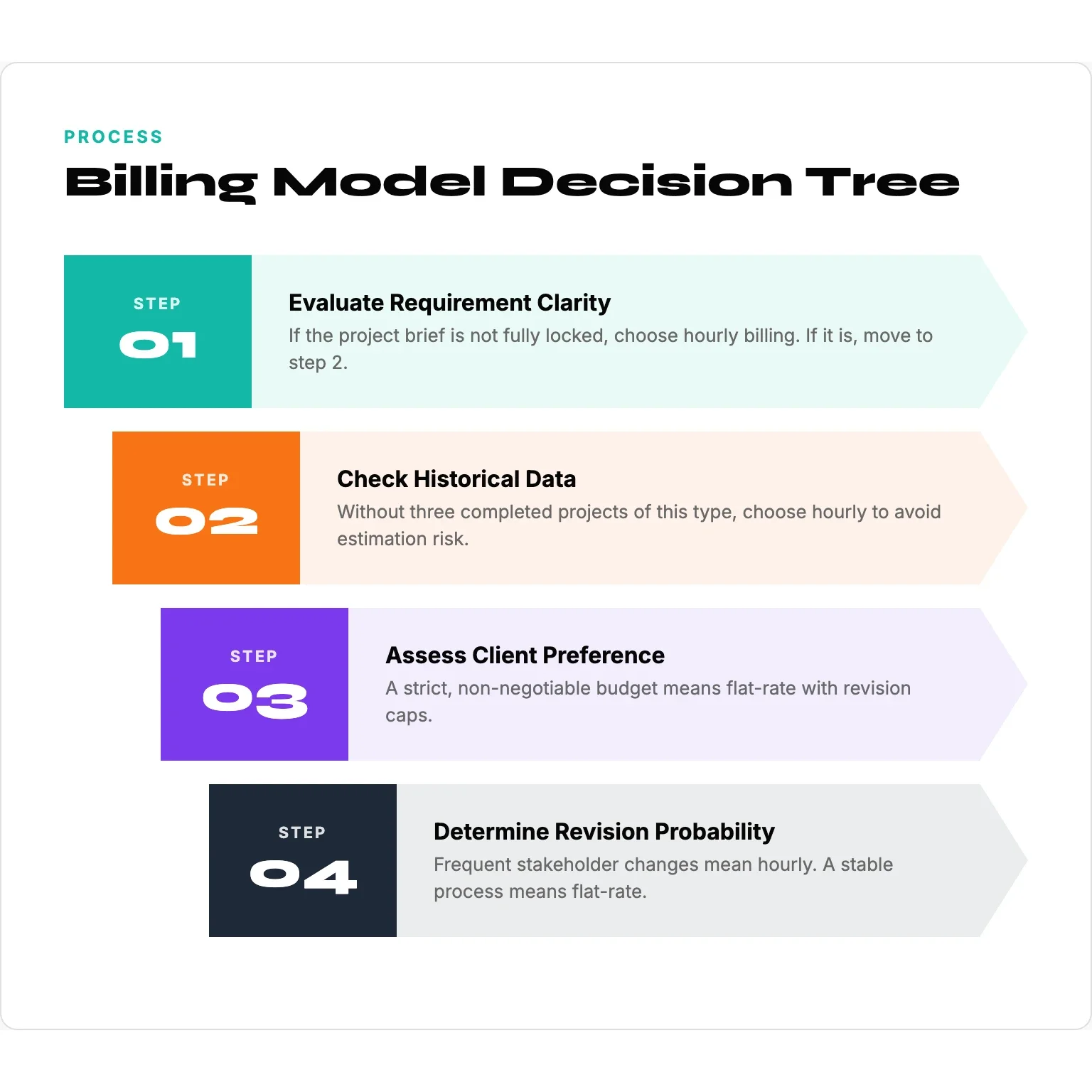
Follow this step-by-step decision sequence when drafting a new client proposal:
- Evaluate Requirement Clarity: Is the project brief completely defined with locked project output requirements? If no, select hourly billing. If yes, proceed to step 2.
- Check Historical Data: Have you completed this exact type of project at least three times before? If no, select hourly billing to protect against estimation errors. If yes, proceed to step 3.
- Assess Client Preference: Does the client require a strict, non-negotiable budget limit before funding approval? If yes, select flat-rate billing with strict revision caps. If no, proceed to step 4.
- Determine Revision Probability: Is the client's internal approval process prone to multiple stakeholder reviews and changing opinions? If yes, select hourly billing. If no, select flat-rate billing.
By systematically evaluating each project against these criteria, freelancers protect their time while offering competitive pricing terms.
Final Thoughts
Choosing between hourly and flat-rate billing is a strategic pricing decision that depends on scope clarity and project risk. Hourly billing protects freelancer earnings on open-ended engagements, while flat-rate billing rewards efficiency on well-defined project tasks. Service providers should evaluate each project independently to select the billing model that maximizes profitability and maintains cash flow stability.
For additional advice on managing client billing schedules and payment terms, explore our complete library of invoicing advice on the blog.
Ready to create professional, accurate invoices for your hourly or flat-rate client projects? Use createinvoices.net to build and send customized PDF invoices with clear payment terms in minutes.